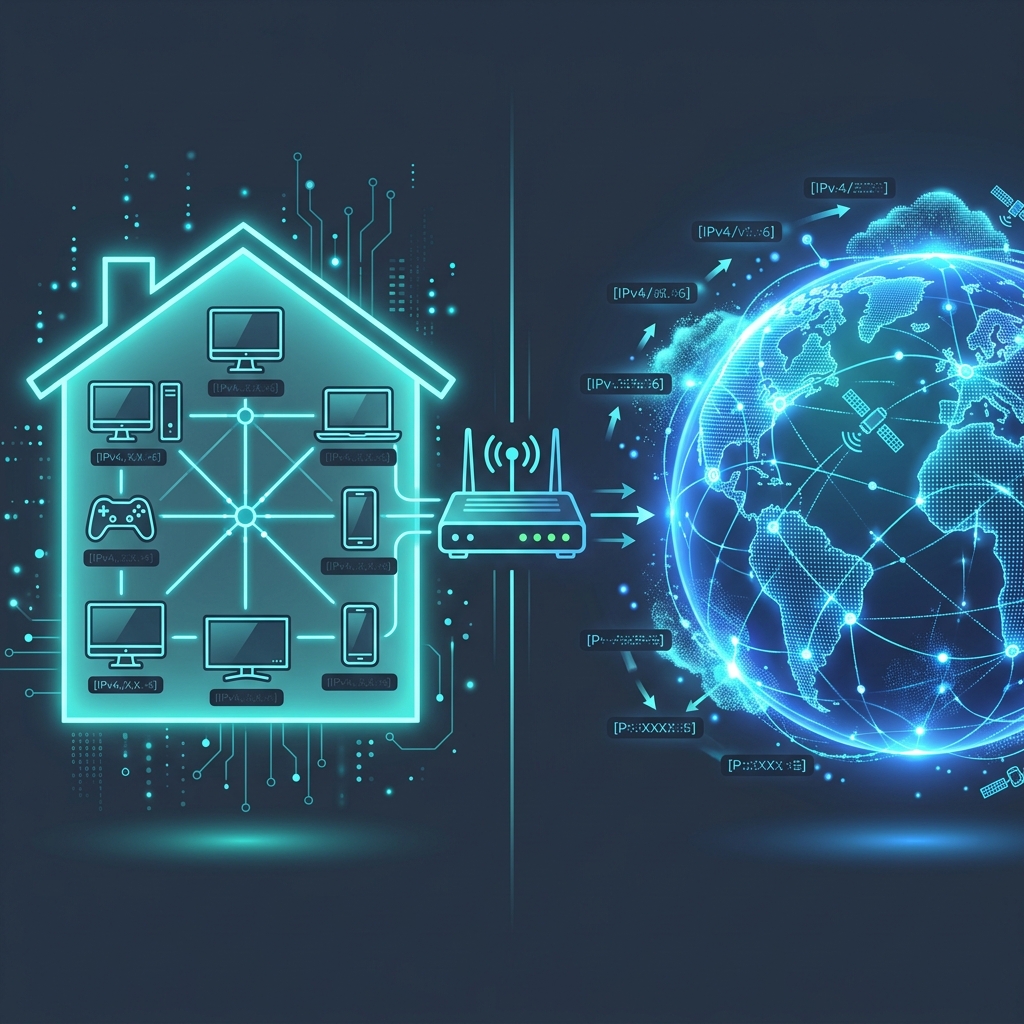
IPv4 vs IPv6: What's the Difference?
A clear comparison of IPv4 and IPv6. Learn the differences in format, capacity, security, and why the internet is transitioning to IPv6.
- Written by
- TraceThatIP Team
- Published
- Reading time
- 5 min read

The Address Crisis
The internet is running on a system designed in 1981. IPv4, the addressing protocol that powers most of the internet today, supports roughly 4.3 billion addresses. That seemed like plenty when personal computers were rare. Today, with 15+ billion connected devices worldwide, we ran out.
IPv6 was designed to solve this problem permanently. It supports approximately 340 undecillion addresses (that is a number with 38 zeros). The transition from IPv4 to IPv6 is the largest infrastructure upgrade in internet history, and it is happening right now.
If you are new to IP addresses, start with our beginner's guide.
IPv4 Explained
Format
IPv4 addresses are written as four decimal numbers separated by dots, called dotted-decimal notation:
Format:  xxx.xxx.xxx.xxx
Example: 192.168.1.1
Range:   0.0.0.0 to 255.255.255.255
Each number represents 8 bits (one octet), for a total of 32 bits. This gives us 2^32 = 4,294,967,296 possible addresses.
IPv4 address structure
Every IPv4 address has two parts:
- Network portion - identifies the network
- Host portion - identifies the specific device
The division between network and host is determined by the subnet mask:
IP Address:   192.168.1.105
Subnet Mask:  255.255.255.0  (/24)
Network:      192.168.1.0
Host:         .105
IPv4 address classes (historical)
The original IPv4 design used five classes:
| Class | Range | Default Mask | Networks | Hosts/Network |
|---|---|---|---|---|
| A | 1.0.0.0 - 126.255.255.255 | /8 | 126 | 16,777,214 |
| B | 128.0.0.0 - 191.255.255.255 | /16 | 16,384 | 65,534 |
| C | 192.0.0.0 - 223.255.255.255 | /24 | 2,097,152 | 254 |
| D | 224.0.0.0 - 239.255.255.255 | - | Multicast | - |
| E | 240.0.0.0 - 255.255.255.255 | - | Reserved | - |
Modern networking uses CIDR (Classless Inter-Domain Routing) instead of classes, allowing more flexible allocation.
IPv4 exhaustion timeline
- 1981: IPv4 introduced (RFC 791)
- 1993: CIDR introduced to slow exhaustion
- 1996: NAT widely adopted (see public vs private IPs)
- 2011: IANA exhausted its free IPv4 pool
- 2015-2019: All regional registries exhausted
- Today: New IPv4 blocks only available through transfers (market price: $30-50 per address)
IPv6 Explained
Format
IPv6 addresses are written as eight groups of four hexadecimal digits, separated by colons:
Full format:    2001:0db8:85a3:0000:0000:8a2e:0370:7334
Shortened:      2001:db8:85a3::8a2e:370:7334
Shortening rules:
- Leading zeros in each group can be dropped:
0db8becomesdb8 - Consecutive groups of all zeros can be replaced with
::(only once per address)
Full:       2001:0db8:0000:0000:0000:0000:0000:0001
Shortened:  2001:db8::1
IPv6 address capacity
IPv6 uses 128 bits, providing 2^128 addresses:
IPv4: 4,294,967,296 addresses
      (4.3 billion)

IPv6: 340,282,366,920,938,463,463,374,607,431,768,211,456 addresses
      (340 undecillion)
To put this in perspective: IPv6 could assign 100 addresses to every atom on the surface of the Earth and still have addresses left over.
IPv6 address types
| Type | Prefix | Purpose |
|---|---|---|
| Global Unicast | 2000::/3 | Public internet addresses (like IPv4 public IPs) |
| Link-Local | fe80::/10 | Local network only (auto-configured on every interface) |
| Unique Local | fc00::/7 | Private addresses (like IPv4 192.168.x.x) |
| Multicast | ff00::/8 | One-to-many communication |
| Loopback | ::1 | Localhost (like IPv4 127.0.0.1) |
Well-known IPv6 addresses
# Google Public DNS
2001:4860:4860::8888
2001:4860:4860::8844

# Cloudflare DNS
2606:4700:4700::1111
2606:4700:4700::1001

# Quad9 DNS
2620:fe::fe
2620:fe::9
IPv4 vs IPv6: Side-by-Side Comparison
| Feature | IPv4 | IPv6 |
|---|---|---|
| Address length | 32 bits | 128 bits |
| Address format | Dotted decimal (192.168.1.1) | Hexadecimal colon (2001:db8::1) |
| Total addresses | ~4.3 billion | ~340 undecillion |
| Header size | 20-60 bytes (variable) | 40 bytes (fixed) |
| Fragmentation | Routers and sender | Sender only |
| Checksum | In header | Removed (handled by L2/L4) |
| NAT required | Yes (address shortage) | No (enough addresses for everyone) |
| IPsec | Optional | Built-in (mandatory support) |
| Auto-configuration | DHCP required | SLAAC (stateless auto-config) |
| Broadcast | Supported | Replaced by multicast |
| DNS record | A record | AAAA record |
Security Differences
IPv4 security
IPv4 was designed without security in mind. IPsec (encryption and authentication) was added later as an optional extension. Most IPv4 traffic is unencrypted at the network layer.
NAT provides accidental security by hiding internal network topology, but NAT was never designed as a security feature. Learn more about how firewalls use IP addresses.
IPv6 security improvements
IPv6 was designed with security built in:
- Mandatory IPsec support - Every IPv6 implementation must support IPsec
- No NAT needed - Eliminates NAT-related vulnerabilities
- Secure Neighbor Discovery (SEND) - Cryptographically signed neighbor discovery
- Larger address space - Makes network scanning attacks harder (scanning a /64 subnet at 1 million addresses per second would take 584,942 years)
However, IPv6 introduces new attack surfaces:
- Dual-stack configurations can be exploited
- IPv6 tunneling can bypass IPv4 firewalls
- SLAAC can expose device MAC addresses (mitigated by privacy extensions)
How to Check Your IPv6 Support
Test if you have IPv6
# Check if your interface has an IPv6 address
# macOS/Linux
ifconfig | grep inet6

# Windows
ipconfig | findstr IPv6
Test IPv6 connectivity
# Ping Google's IPv6 DNS
ping6 2001:4860:4860::8888

# Or on newer systems
ping -6 google.com
Check your public IPv6 address
Visit What's My IP - if your ISP supports IPv6, both your IPv4 and IPv6 addresses may be detected.
Dual-Stack: Running Both Protocols
Most modern networks run dual-stack - both IPv4 and IPv6 simultaneously. This allows communication with both IPv4-only and IPv6-only services.
Your device
  ├── IPv4: 192.168.1.105  → IPv4 internet
  └── IPv6: 2001:db8::105  → IPv6 internet
When connecting to a dual-stack website, your operating system uses the Happy Eyeballs algorithm (RFC 6555) to try both IPv4 and IPv6 simultaneously and use whichever responds first.
IPv6 Adoption Rates
As of 2026, IPv6 adoption varies significantly by country:
| Country | IPv6 Adoption |
|---|---|
| India | ~70% |
| United States | ~50% |
| Germany | ~60% |
| Japan | ~55% |
| Brazil | ~40% |
| Australia | ~30% |
| China | ~35% |
Google reports that approximately 45% of all traffic to their services comes over IPv6. The adoption rate is growing steadily at 5-10% per year.
What This Means for You
For regular users: IPv6 is mostly invisible. Your ISP and operating system handle it automatically. You do not need to configure anything.
For developers: Ensure your applications support both IPv4 and IPv6. Test with IPv6 addresses. Use address-family-agnostic socket APIs.
For network administrators: Plan your IPv6 deployment now if you have not already. Dual-stack is the recommended transition strategy.
Summary
IPv4 is the protocol that built the internet, but its 4.3 billion address limit is now exhausted. IPv6 provides a permanent solution with a virtually unlimited address space, built-in security, and simpler header processing. The transition is happening gradually through dual-stack deployments.
Explore further:
- What is an IP address? - IP fundamentals
- Public vs Private IPs - How NAT works
- Trace any IP address - Look up IPv4 or IPv6 addresses
- Check your public IP
Topics